The Black National Anthem Started as a Poem about Abraham Lincoln

Some songs flow out of an artist as if by divine inspiration; some songs must be arduously wrung out of the creative mind like the last drops of water from a damp towel. The song “Lift Ev’ry Voice and Sing,” often referred to as America’s Black National Anthem, was composed in 1900 by artists who faced a bit of both experiences. Written by two black men to celebrate Abraham Lincoln’s birthday at a segregated school in Florida, the song was composed, performed, then promptly forgotten about by its creators — but the song lived on, spread from person to person, until it became so powerful that within 20 years of its debut it was declared the Negro National Hymn.

Today, “Lift Ev’ry Voice and Sing” (now usually titled more modernly as “Lift Every Voice and Sing”) is one of the most cherished songs of the African American Civil Rights Movement; it was added to the National Recording Registry in 2016, and it has been performed and recorded countless times at seminal events by some of the greatest artists who ever lived.

Strangely, most people in the US have never heard of it and don’t know there even is a Black National Anthem; those few people who are aware of the song know little about it. But the song’s conception and history are definitely worth knowing, not just for its cultural value — which is immense — but for its inspiration, its insight into the art of songwriting, and for what it says about the indefatigable power of music.

“The lines of this song repay me in an elation, almost of exquisite anguish, whenever I hear them sung by Negro children,” stated James Weldon Johnson, who wrote the lyrics, while his brother, J. Rosamond Johnson, composed the music. “Nothing that I have done has paid me back so fully in satisfaction as being the part creator of this song.”

The Johnson Brothers

James Weldon Johnson and Rosamond Johnson, circa 1937. Courtesy James Weldon Johnson and Grace Nail Johnson Papers. Yale Collection of American Literature, Beinecke Rare Book and Manuscript Library.

The Johnson brothers today are considered two of the most important figures in early 20th century Black intellectual and artistic circles — and they would be considered so even if they had not written “Lift Ev’ry Voice and Sing.”

James Weldon Johnson

James was an author, lyricist, poet, diplomat, attorney, and leader of the National Association for the Advancement of Colored People (NAACP). Born in 1871 in Jacksonville, Florida, he was trained in music and other subjects by his mother, who was a schoolteacher. James graduated from Atlanta University with undergraduate (1894) and graduate (1904) degrees, and later studied at Columbia University. While teaching school early in his career, he began studying law and in 1898 became the first Black man admitted to the Florida Bar since Reconstruction.

During this period, James was also a poet, writer, and lyricist, and in 1901 he and his brother John Rosamond Johnson (who went by J. Rosamond Johnson) went to New York, where they wrote some 200 songs for the Broadway musical stage. In New York, James began making connections to influential members of the Black community. After serving as treasurer for the Colored Republican Club, Johnson was appointed the US consul in Venezuela by President Theodore Roosevelt in 1906. Three years later, Johnson was moved to Nicaragua to serve as consul there. During this time, Johnson continued to write poetry and anonymously published his novel, The Autobiography of an Ex-Colored Man (1912), a story of a young biracial man living in the post-Reconstruction era.

James eventually left the diplomatic field to join the civil rights movement as a leader in the NAACP. He started as a field secretary in 1916 and ultimately became executive secretary of the organization.

Throughout the 1920s, James supported and promoted the Harlem Renaissance. According to his official NAACP biography, “Johnson believed Black Americans should produce great literature and art in order to demonstrate their equality to whites in terms of intellect and creativity.” In addition to his Autobiography of an Ex-Colored Man, James authored three other books of nonfiction and three collections of poetry; he also edited three poetry anthologies and taught creative writing at Fisk University in Nashville.

He died in 1938 at the age of 67 in a car accident.

John Rosamond Johnson

John Rosamond Johnson had a varied career as a pianist, songwriter, producer, soldier, singer, and actor. Born in 1873 in Jacksonville, Florida, J. Rosamond began playing the piano at age four. He studied at the New England Conservatory and, by the end of the 19th century, was teaching schoolchildren in the Jacksonville region.

John moved to New York City in 1900 with his brother James to find success on Broadway. According to the Library of Congress, John was one of the more important figures in black music in the first part of the 20th century. After contributing a song to Williams and Walker’s Sons of Ham (1900), Johnson created a vaudeville act and wrote songs with Robert Cole. This partnership (which often also included James in the songwriting) lasted until Cole’s death in 1911. Besides crafting a sophisticated vaudeville style, Cole and Johnson produced two popular all-black operettas on Broadway, The Shoo-Fly Regiment (1907) and The Red Moon (1909). In addition to musicals, John wrote popular songs and works for piano.

Along with his musical work, John performed important work in literature, education, and the military. At the onset of World War I, he put his performing career on hold and accepted a commission as a second lieutenant in the 15th New York National Guard Regiment, which consisted mostly of African Americans. The unit spent more days in the frontline trenches than any other American unit, also suffering the most losses. 

After the war, John continued writing and performing. He also worked as a literary editor, collecting four anthologies of traditional African American songs — two of which he compiled with his brother James: The Book of American Negro Spirituals (1925) and The Second Book of Negro Spirituals (1926). John also founded a school in Harlem called the New York Music School Settlement for Colored People and served as its music director.

He died in New York City in 1954.

The Song and Its Creation

“Lift Ev’ry Voice and Sing” is a hymn of agony and hope for Blacks in the United States at the turn of the 20th century, of overcoming the dark past of slavery and facing the future with a faithful optimism and patriotic loyalty:

Lift every voice and sing
Till earth and heaven ring,
Ring with the harmonies of Liberty;
Let our rejoicing rise
High as the listening skies,
Let it resound loud as the rolling sea.
Sing a song full of the faith that the dark past has taught us,
Sing a song full of the hope that the present has brought us.   
Facing the rising sun of our new day begun,
Let us march on till victory is won.


Stony the road we trod,
Bitter the chastening rod,
Felt in the days when hope unborn had died;   
Yet with a steady beat,
Have not our weary feet
Come to the place for which our fathers sighed?
We have come over a way that with tears has been watered,
We have come, treading our path through the blood of the slaughtered,
Out from the gloomy past,   
Till now we stand at last
Where the white gleam of our bright star is cast.


God of our weary years,   
God of our silent tears,
Thou who hast brought us thus far on the way;
Thou who hast by Thy might   
Led us into the light,
Keep us forever in the path, we pray.
Lest our feet stray from the places, our God, where we met Thee,
Lest, our hearts drunk with the wine of the world, we forget Thee;
Shadowed beneath Thy hand,   
May we forever stand.   
True to our God,
True to our native land.
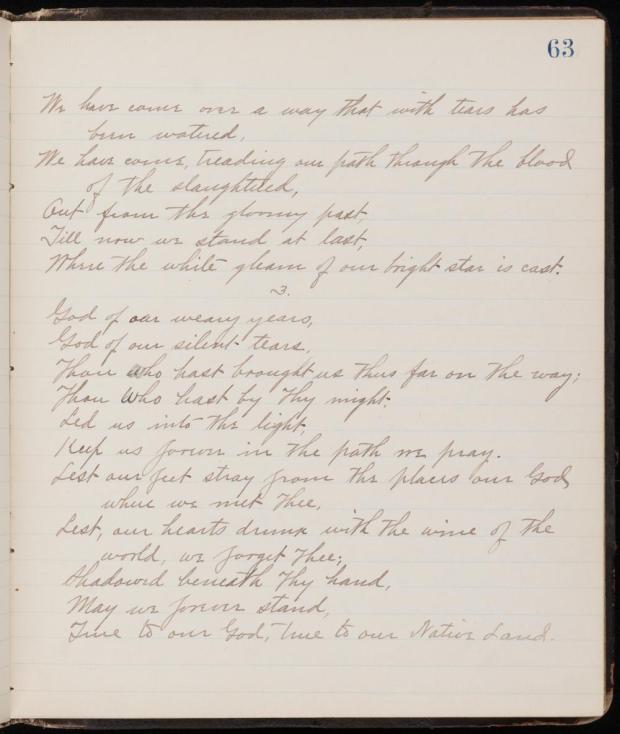
(From Saint Peter Relates an Incident by James Weldon Johnson. Copyright © 1917, 1921, 1935 James Weldon Johnson, renewed 1963 by Grace Nail Johnson.)
Handwritten page from original manuscript of “Lift Ev’ry Voice and Sing.” Courtesy James Weldon Johnson and Grace Nail Johnson Papers. Yale Collection of American Literature, Beinecke Rare Book and Manuscript Library.

James Weldon Johnson wrote and spoke about the creation of the song multiple times, but the most detailed version is from his 1933 autobiography, Along This Way:

A group of young men decided to hold on February 12 a celebration of Lincoln’s birthday. I was put down for an address, which I began preparing; but I wanted to do something else also. My thoughts began buzzing round a central idea of writing a poem on Lincoln, but I couldn’t net them. So I gave up the project as beyond me; at any rate, beyond me to carry out in so short a time; and my poem on Lincoln is still to be written. My central idea, however, took on another form. I talked over with my brother the thought that I had in mind, and we planned to write a song to be sung as part of the exercises. We planned, better still, to have it sung by schoolchildren — a chorus of five hundred voices.

I got the first line:—Lift ev’ry voice and sing. Not a startling line; but I worked along grinding out the next five. When, near the end of the first stanza, there came to me these lines

Sing a song full of the faith that the dark past has brought us.
Sing a song full of the hope that the present has brought us.

the spirit of the poem had taken hold of me. I finished the stanza and turned it over to Rosamond.

In composing the two other stanzas I did not use pen and paper. While my brother worked at the musical setting I paced back and forth on the front porch, repeating the lines over and over to myself, going through all the agony and ecstasy of creating. As I worked through the opening and middle lines of the last stanza:

God of our weary years,
God of our silent tears,
Thou who has brought us thus far on the way,
Thou who has by thy might
Led us into the light,
Keep us forever in the path, we pray;
Lest our feet stray from the places, our God, where we met Thee,
Lest, our hearts drunk with the wine of the world, we forget Thee…

I could not keep back the tears, and made no effort to do so. I was experiencing the transports of the poet’s ecstasy. Feverish ecstasy was followed by that contentment — some sense of serene joy — which makes artistic creation the most complete of all human experiences.

After the lyrics were done and Rosamond had completed composing the music, the brothers sent the song to their publishers in New York, Edwin B. Marks Company, asking for enough mimeographed copies for the children’s chorus performance on February 12. The song was sung at the event, it went very well, and the two brothers both moved away from Jacksonville, Florida, and forgot all about their composition. But, as James recalled later:

The schoolchildren of Jacksonville kept singing the song; some of them went off to other schools and kept singing it; some of them became schoolteachers and taught it to their pupils. Within twenty years the song was being sung in schools and churches and on special occasions throughout the South and in some other parts of the country. Within that time the publishers had recopyrighted it and issued it in several arrangements. Later it was adopted by the National Association for the Advancement of Colored People, and is now quite generally used throughout the country as the ‘Negro National Hymn’. …

Nothing that I have done has paid me back so fully in satisfaction as being the part creator of this song. I am always thrilled deeply when I hear it sung by Negro children. I am lifted up on their voices, and I am also carried back and enabled to live through again the exquisite emotions I felt at the birth of the song. My brother and I, in talking, have often marveled at the results that have followed what we considered an incidental effort, an effort made under stress and with no intention other than to meet the needs of a particular moment. The only comment we can make is that we wrote better than we knew.

“Lift Ev’ry Voice” – History and Legacy

The subsequent history of the song “Lift Ev’ry Voice and Sing” is alive and permanent:

The song was first recorded in 1923 by the male gospel group Manhattan Harmony Four.

It was subsequently featured in the 1939 film Keep Punching and then in the 1989 film Do the Right Thing (with a 30-second clip of the song played on solo saxophone by Branford Marsalis).

The song eventually was adopted by NAACP and prominently used as a rallying cry during the Civil Rights Movement of the 1950s and 1960s. 

In 2009, the Rev. Joseph Lowery used the song’s third stanza to begin his benediction at the inauguration for America’s first Black president, Barack Obama.

In 2016, the song was sung at the conclusion of the opening ceremonies of the National Museum of African American History and Culture in Washington, DC, and was also added to the National Recording Registry.

Since 2020, the song has seen a new resurgence in popularity — and a growth in the awareness of its general existence — due to the massive expansion of the Black Lives Matter movement in the Unites States in response to the murder of George Floyd.

Links For More Information

Want to learn more? Check out these resources:

The Harlan-Lincoln House in Iowa is Reborn – and Needs Our Help

An important piece of Abraham Lincoln’s legacy was nearly lost in 2023, but an intrepid group of citizens of Mount Pleasant, Iowa saved it. Now, the non-profit Harlan-Lincoln House, Inc., Board of Directors is working to build both a sustainable organization and an enduring and recognized historical site, and is looking for assistance in terms of guidance, fundraising, scholarship, and publicity.

The Harlan-Lincoln House was the home of U.S. Senator James Harlan, a friend and political confidante of President Abraham Lincoln. Harlan’s daughter Mary married Lincoln’s oldest son Robert, and the Civil War president’s grandchildren were constant visitors to the house in Mount Pleasant. “So very restful,” Mary Harlan Lincoln said of her father’s home, “and so good for the children growing up.”

The house was given to Iowa Wesleyan University by Mary Harlan Lincoln in 1907, after which it was used for housing and academic purposes for decades before being turned into a museum in 1959. It was added to the U.S. Register of Historic Places in 1973.

The Harlan-Lincoln House as it looked in 1907

“It’s a midwestern family story that has national prominence,” said Elizabeth Garrels, chair of the Harlan-Lincoln House, Inc. Board of Directors, and a former trustee of Iowa Wesleyan University. “It’s James Harlan’s story of public service, his friendship with the most beloved president ever, and a unique place often visited by the Lincoln descendants — all of these make it a real treasure.”

James Harlan, like Abraham Lincoln, was a product of Illinois and Indiana before becoming a lawyer. Unlike Lincoln, Harlan was well educated, and spent time as a teacher and college president before being elected to the U.S. Senate in 1855. Harlan was a political supporter and friend of President Lincoln, and in 1865 was nominated by Lincoln to be Secretary of the Interior. Harlan served in that role for one year under President Andrew Johnson, but resigned in protest of Johnson’s reconstruction policies. Harlan returned to the Senate in 1867, where he served until losing reelection in 1872.

James Harlan, 1865

During his “retirement” years after returning home to Mount Pleasant, Harlan remained politically active in the Republican Party, served as a trustee of Iowa Wesleyan University (the institution he formerly presided over), and served four years as chief judge of the second court of Alabama claims. He died in 1899.

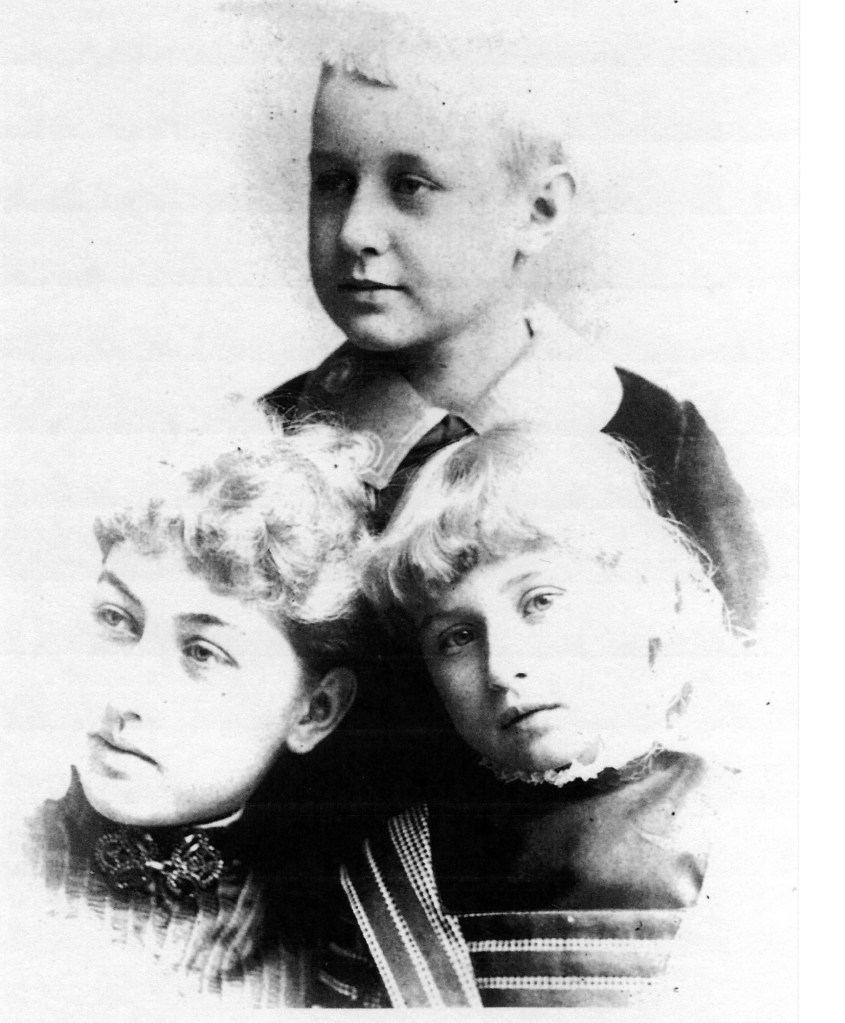
The Harlan and Lincoln families became intertwined in 1868 when Mary Harlan married Robert Lincoln — a match specifically cultivated by First Lady Mary Lincoln. The Lincolns had three children — Mary (born 1869), Abraham II (born 1872), and Jessie (born 1875) — and Mary and the children spent multiple weeks of every year (often entire summers) staying with the Harlan grandparents in their Iowa home. Stories of the Lincoln children frolicking around Mount Pleasant are legion, and the house still contains numerous relics of their childhood, including their tennis net, a rock collection, and even the children’s heights and ages marked in pencil on a doorframe. As the children got older, Mount Pleasant also became the place Mary Harlan Lincoln sorted through her deceased mother-in-law’s sixty trunks of possessions, where Jessie met the college baseball player she later scandalously eloped with, and even where Jessie’s second child was stillborn and buried.

Mary, Abraham II, and Jessie Lincoln

“A lot of people have questions about the descendants of Abraham Lincoln and who they were, and we are in a position to answer those questions,” said historian Paul Juhl, author of the book The James Harlan and Robert Todd Lincoln Families’ Mount Pleasant Memories and a member of the Harlan-Lincoln House, Inc. Board of a Directors. “This site is a little-known part of the Lincoln story.”

While not a part of the typical Lincoln trail of historic sites in Illinois, Indiana, Kentucky, and Washington, D.C., the Harlan-Lincoln House attracted many visitors every year and was a jewel of Iowa Wesleyan University, sitting on the north side of the campus. Lincoln-themed lectures and events were held in the university’s chapel annually, while visitors to Mount Pleasant typically took time to visit the house connected so tangibly to the Lincoln family, particularly to see the piece of Abraham Lincoln’s coat from the night he was assassinated and one of Mary Lincoln’s mourning veils, both of which are part of the site’s collections.

When Iowa Wesleyan was forced to close in spring 2023 due to declining enrollment and lack of funds, the future of the Harlan-Lincoln House — and all the historical artifacts and archives contained within it — was uncertain. But after six months of discussions, the university transferred ownership of the house and its contents to newly formed non-profit last October.

“We are really quite pleased with the conclusion,” said Garrels. “We appreciate the fact that we have this house to share — it could have gone other ways.”

The mission of the Harlan-Lincoln House, Inc. is to preserve and promote the house and its contents, highlighting its relevance to the James Harlan and Abraham Lincoln families, and “to explain the significant impact of these prominent American families who offered vital leadership for the life of Iowa Wesleyan University, community of Mount Pleasant, state of Iowa, and the nation.”

But with ownership comes responsibilities. All of the financial and personnel resources needed to run the historic site, which were previously provided by the university, are now the burden of the non-profit. “None of us ever thought we’d be in this position,” said Garrels about the new board of directors. “We’re working to get our feet on the ground, get the site launched with docents, publicity, and being open regularly for visitors.” There is also the ever-present need for fundraising, and the goal to make the Harlan-Lincoln House an inviting tourist destination for Lincolnphiles.

“We’re not that far from Springfield and the Lincoln sites in Illinois, only about three hours,” Juhl said. “It’s a nice day trip that we do with bus groups, and we hope people will realize we’re out here and come visit.”

For more information on the Harlan-Lincoln House and its future endeavors, visit the website at https://harlanlincoln.org or email Elizabeth Garrels at regarrels@iowatelecom.net.

Robert Lincoln speaks at Knox College

Robert Lincoln rarely spoke at public functions about his father or his father’s legacy, but one major exception he made was the October 7, 1896 celebration of the thirty-eighth anniversary of the Lincoln-Douglas Debate held on the Knox College campus.

Robert had decided in the immediate years after his father’s death not to speak at public functions in his honor. As he told one correspondent in July 1896, “I have had to make up my mind to refrain from attending these celebrations of the birthday of my father …. It has always seemed to me that I should be out of place and so I have with absolute uniformity sent my regrets to a large number of invitations I receive every year …. I really feel I should let such meetings be free from any element which would be caused by my presence.”

The fall of 1896 was different, however. Robert was only a few years returned from serving four years as the United States Minister to Great Britain, and he had decided to participate in the 1896 presidential election by making speeches across the Midwest for the Republican ticket of William McKinley and Theodore Roosevelt. Before he started his speaking tour on October 15, Robert Lincoln traveled to Galesburg, Illinois, to participate in two massive celebrations.

The first was the dedication of a Civil War soldiers’ monument in Hope Cemetery. Lincoln gave an extensive speech concerning the reasons and the beginnings of the civil war—“The gloom of those threatening days can never be forgotten by those who had passed the age of childhood,” he said—and the meaning of the conflict and the sacrifice of those who fought for liberty. “For this we come today to the graves of these dead soldiers, who were of the men willing to give their lives that their country might live,” Lincoln said in a statement evocative of his father’s hallowed Gettysburg Address. “We should never cease our thanks to God that their offered gift was not in vain. . . . One great lesson to be learned from the lives of these men and their comrades is that there is no danger to the Republic so great that it may not be overcome by the union of patriots. . . . No one lives under its flag who does not at heart rejoice that the rock of Disunion was exploded form its path and the canker of human slavery torn from its framework.”

The second event the day was at Knox College for the celebration of the thirty-eighth anniversary of the Lincoln-Douglas Debate held on that campus in 1858. The Galesburg debate was the fifth of the famous debates between Abraham Lincoln and Stephen A. Douglas in the senatorial contest of 1858. It is seen as the turning point in the campaign in which Abraham Lincoln began to stress the moral issue of slavery as one of right versus wrong, rather than mere politics.

The day of the 1896 commemorative event celebration, October 7, broke crisp, warm, and cloudless in Galesburg. More than 20,000 people thronged the town and the college campus. The main speaker of the day was Chauncey M. Depew—a renowned orator, New York State politician, and railroad executive—who paid an eloquent tribute to Abraham Lincoln. U.S. Sen. John M. Palmer, who knew both Lincoln and Douglas, also gave a long tribute to both men; and Frank Hamlin, son of Lincoln’s first vice president, Hannibal Hamlin, also gave a brief address. But the one speaker who drew thousands of people to the crowd was ex-Minister to Great Britain, Robert T. Lincoln.

Robert’s speech that day was one of the rare times in his life in which he publicly spoke about his father. His participation is evidence of his deep reverence not only for his father, but also for the historic importance of the debates themselves and the part his father played in eradicating slavery. Standing on the platform facing 20,000 people, with a bust of his father on the platform beside him, Robert Lincoln, portly, bearded, and impeccably dressed—looking, in fact, nothing like Abraham Lincoln—said:

“On an occasion of this peculiar significance it would suit me far better to be a listener or to give you hearty assurance of the grateful emotions that overcome me on witnessing this demonstration of respect for my father. He knew that here he had many sympathizing friends, but what would have been his feelings could he have known that after nearly forty years, after his work was done over thirty years, there would come together such a multitude as this to do him honor! It is for others and not for me to say, I will give expression to but a few thoughts….

“The issues of 1858 have long been settled. My father called the struggle one between right and wrong. In spite of the great odds against him he battled on, sustained by conscience and supported by the idea that when the fogs cleared away the people would be found on the side of right….

“He was right, and today not a man could be found who would not resist the evil against which he protested. This should give us confidence in our battle against the evils of our own times. Now, as then, there can be but one supreme issue, that between right and wrong. In our country there are no ruling classes. The right to direct public affairs according to his might and influence and conscience belongs to the humblest as well as to the greatest. The elections represent the judgments of individual voters. Perhaps in times one vote can destroy or make the country’s prosperity for thirty years. The power of the people, by their judgments expressed through the ballot box, to shape their own destinies, sometimes makes one tremble. But it is times of danger, critical moments, which bring into action the high moral quality of the citizenship of America. The people are always true. They are always right, and I have an abiding faith they will remain so.”

One of the thousands of people in attendance that day was 18-year-old Carl Sandburg, who was working at the time driving a milk wagon and would later become a world-renowned poet and Lincoln scholar. In a February 1953 article in Life magazine, Sandburg remembered the day: “I got away from my milk wagon long enough to have a look at Robert Lincoln, and as I watched him I found myself wondering what kind of talks he had had with his father in the White House. He made a short speech, and he didn’t say anything that I went home thinking about.”

news clipping from the New York Journal, October 8, 1896

One week later, Robert Lincoln began campaigning for the Republican presidential ticket. His first event was to preside over the American Republican College League meeting in Chicago on Oct. 15, where Theodore Roosevelt was the featured speaker. The next week, Lincoln began a whirlwind speaking tour around the Midwest. He gave three speeches in Minnesota, four in Illinois, and two in Indiana, each time appearing before crowds of tens of thousands of people. In his speeches, Lincoln supported McKinley, the Republican Party, and the continuance of the gold standard, and he railed against the Democrats for wanting to kill American businesses and destroy the American economy. After returning home to Chicago on Nov. 1, Robert wrote to John Hay, “There is nothing I hate as much as speech making, but I started out two weeks ago and have been at it ever since.”

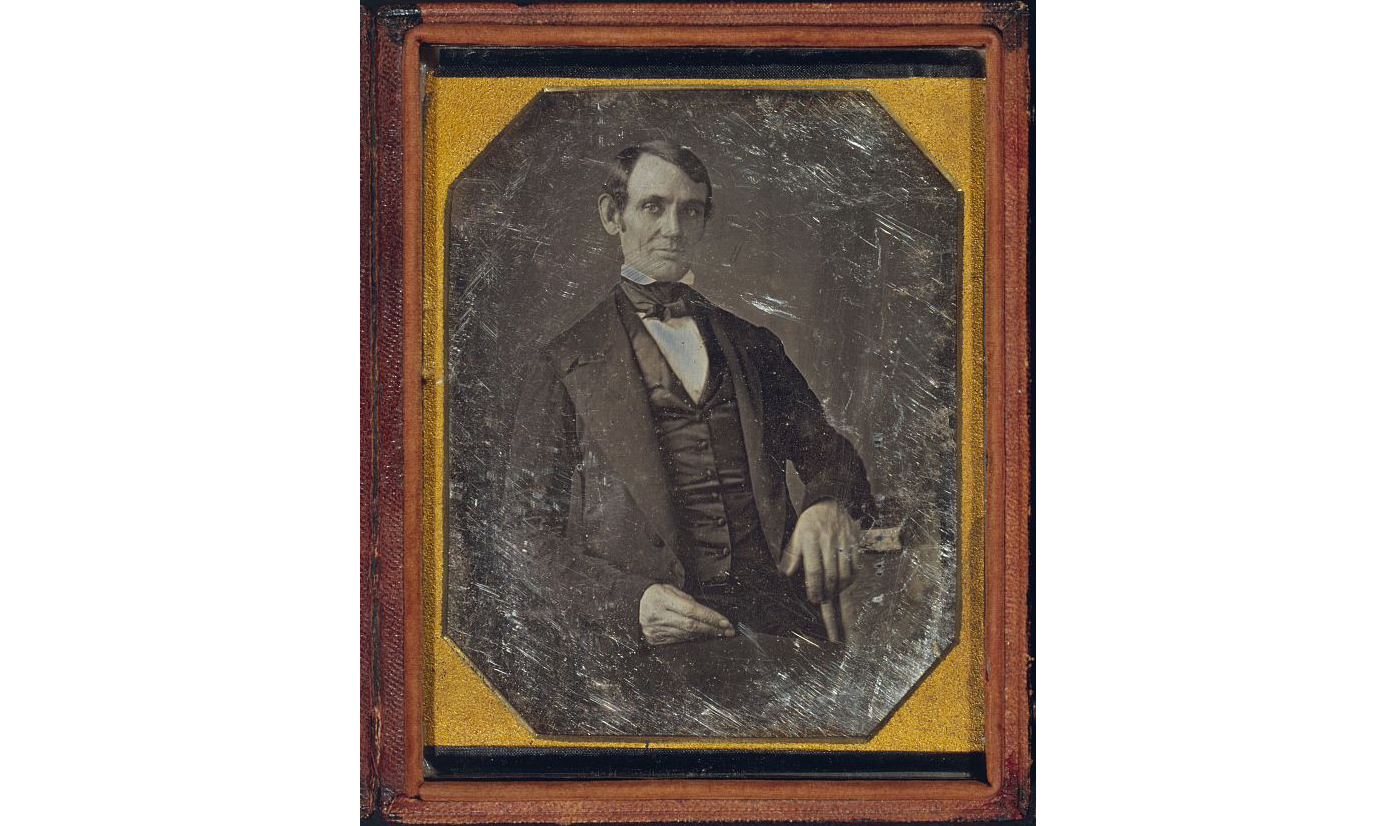
The earliest picture of Abraham Lincoln

The earliest known photo of Abraham Lincoln is well known and commonly seen today, but did you know it was not known to the public until 1895?

The daguerreotype, attributed to photographer Nicholas H. Shepherd, was taken in 1848 when Lincoln was a 37-year-old frontier lawyer in Springfield, Illinois, and a Congressman-elect.

This picture — along with an accompanying one of Mary Lincoln from the same year — hung in the Lincolns’ home for decades (from the time oldest son Robert said he could first remember as a child growing up). Whether it was hung in the White House is unknown, but after the assassination Mary Lincoln kept with her belongings as she traveled the United States and the world. After her death, the photos became the property of Robert Lincoln, the oldest and only surviving Lincoln son.

Interestingly, the existence of this photo was not public knowledge until December 1895, when it was published in McClure’s magazine with the permission of Robert Lincoln. McClure’s obtained the image after Robert T. Lincoln had revealed its existence to writer Ida Tarbell when she interviewed him in Chicago early in 1895. Tarbell related in her book, All in the Day’s Work, her meeting with Robert in Chicago and his offer of the unpublished daguerreotype to her for her article. “I held my breath. If it was true!” she wrote. “I held my breath still longer when the picture was finally in my hands for I realized that this was a Lincoln which shattered the widely accepted tradition of his early shabbiness, rudeness, ungainliness. It was another Lincoln, and one that took me by storm.”

The photo also took the country and the world by storm when it was published in McClure’s. The magazine even did a follow-up article just on the public reaction to the photo, including quotes from national figures opining on the image.

Two people who were not impressed, but rather upset about the publication of the Lincoln daguerreotype, were John Hay and John Nicolay, Abraham Lincoln’s White House secretaries and historians in the midst of completing a multi-volume life of Lincoln. The two were also personal friends with Robert Lincoln, and Robert gave them exclusive access to all of his father’s papers and materials for their book.

Robert wrote to Hay in November 1895 explaining how and why he gave the photo of his father to Tarbell to print, and not to Hay and Nicolay:

“It was among a lot of inconsequential things kept packed up by my mother which I examined carefully for the first time, after I returned from England in 1893. This examination was a business that I might have done at any time after her death in 1882 but there was no reason for thinking it of consequence, and I dreaded it.”

Robert added that he decided to give the photo to Tarbell to use “to put her under a little obligation to me,” which he said, appears to have worked.

Mary Lincoln Isham, Robert T. Lincoln’s daughter, presented the original daguerreotype of Lincoln to the Library of Congress in October 1937.

The Mary Lincoln Polka

Have you ever heard “The Mary Lincoln Polka,” which was premiered on Feb. 5, 1862 at the (now infamous) White House ball? Did you know you can listen to it today?

The polka was written in honor of the First Lady by Francis Scala, leader of the U.S. Marine Band. After the Lincoln administration ended, however, there is no record of the polka ever being performed again and the music was apparently lost to history. But then Jane Gastineau of the Lincoln Collection of the Allen County (Indiana) Public Library found the manuscript in the archives of the Marine Band.

Evanston, IL, attorney Michael Poulos transcribed and arranged this music for a small ensemble consisting of members of the Chicago Bar Association Symphony Orchestra, and he lead its performance in a concert in Representative Hall of the Old State Capitol in Springfield, IL, on President’s Day weekend, 2013.

You can listen to the performance on this website: https://cdm16089.contentdm.oclc.org/…/c…/p15155coll1/id/2343

The original score is now part of the Lincoln Financial Foundation Collection, whose management is shared by the Indiana State Museum and the Allen County Public Library.